
Hey – happy Sunday! While I know this newsletter has mainly focused on politics for the first two months, I want to fill you in on a little change, dear reader: I will not continue writing exclusively about political data. I plan to explore some of my other interests outside of politics in this newsletter. This week, I am writing about public health, and I have a cool post about higher education in the works, as well. I hope your broken heart recovers, and I truly hope you stick around. With that said, let’s get into it.
Most of us remember the COVID-19 pandemic well – but do we remember our governments’ responses to the pandemic with the same clarity? Probably not. This Sunday’s post will cover those government responses around the world.
This week’s graphs use data from ACAPS. See the first one below:
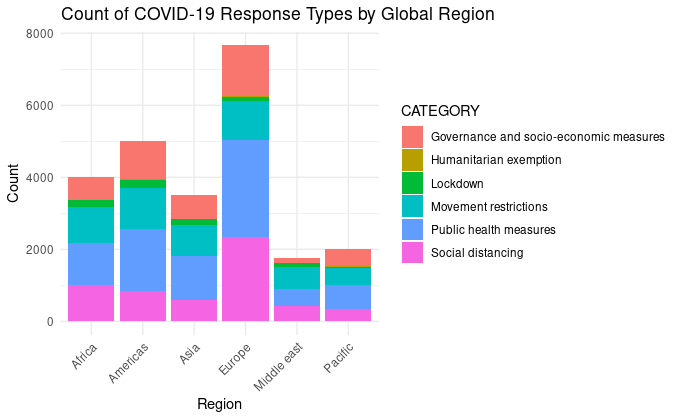
As you can see, different regions responded in very different yet fairly predictable ways.
Europe implemented the most COVID restrictions, followed by the Americas, Africa, Asia, Oceania, and the Middle East. I found it surprising that Asia was so low considering the huge efforts made by China to limit the spread of the virus.
It is also interesting to me to look at the different kinds of COVID restrictions implemented by region. In Europe and the Americas, public health measures made up the largest policy category – followed closely by social distancing measures. In other regions like the Middle East and Africa, however, movement restrictions made up the largest share of policies. This might show more suspicion of and hostility towards outsiders in these regions.
To get more detail, let’s look at a few selected countries. See below:

Here, it can be seen that specific COVID restrictions varied pretty wildly by country.
In the United States, almost no social distancing measures were put in place at the federal level; instead, our federal government spent almost all of its efforts on implementing public health measures. Additionally, the large socio-economic measures shown were the stimulus checks and payments to businesses passed in 2020.
In the United Kingdom, social distancing was taken much more seriously. Just about half of the UK’s measures were social distancing-related, and public health measures made up a much smaller share of their government’s actions.
In Germany, however, public health was much more important to the national government. The same was true with China.
Saudi Arabia is an interesting case because their government did very little outside of instituting movement restrictions. This, again, is likely because Saudi Arabia is very suspicious of outsiders.
In the coming years, it will be interesting to see how other crises will be handled around the world. Will the United States continue to throw money at all of its problems? Will the UK and Germany continue to divide Europe? Will China continue its authoritarianism? These will be very important questions for social scientists in the future.
Thanks for reading and I’ll see you next Sunday. Don’t forget to subscribe!


Leave a comment