
American politics in recent years has been defined by culture war. Our discourse is dominated by social issues to a degree we have never seen before, and marginalized groups are playing defense in a way reminiscent of less enlightened decades in our history. While the Democrats certainly have their flaws and ideological inconsistencies, I believe the Republican Party and the conservative media industrial complex are largely responsible for driving polarization. While there are obviously many areas where American conservatives have moved increasingly to the right, this week’s newsletter will focus on a particularly salient topic: race. There is a measurable mathematical link between conservative ideology and levels of racial resentment, and I intend to make that clear in this post.
First, let’s get some definitions out of the way. “Racial resentment” is the scholarly term for the more subtle (but still insidious) forms of racial bias seen commonly in interracial social interaction. Racial resentment often presents itself in not-so-obvious ways – think opposition to affirmative action policies or dismissals of the systemic inequalities faced most often by black Americans in our institutions. Racial resentment is contrasted with more overt racist sentiment known as “racial prejudice.” Racial prejudice has mostly fallen out of fashion in the United States (we no longer have de jure segregation, for example), but racism obviously still plays a large role in American social and political life.
It is important to make clear as I’m gearing up to argue with numbers that I do not believe everyone who identifies as a conservative is a racist. I am a resident of Oklahoma with many non-racist friends who identify as conservative. Less anecdotally, a large wing of the Republican Party fits more into the establishment, neoconservative bucket – think George W. Bush or the late John McCain – and these conservatives are often rather moderate on racial issues. I do think, however, that the MAGA wing of the Republican Party is overtly racist and white nationalist. My argument going forward can be summarized thusly: conservatives aren’t necessarily racist, but racists are nearly always conservative.
To support my controversial claims made so far, I of course have data – isn’t that what you come here for? I sourced this week’s analysis from the CES (the gold-standard of exit polling and a source of survey data commonly used for political analysis). The graph for this week is a personal favorite format – a violin plot. Violin plots show continuous distribution: the graphs increase in width at points representing more people and get thinner at points representing fewer people. See below:
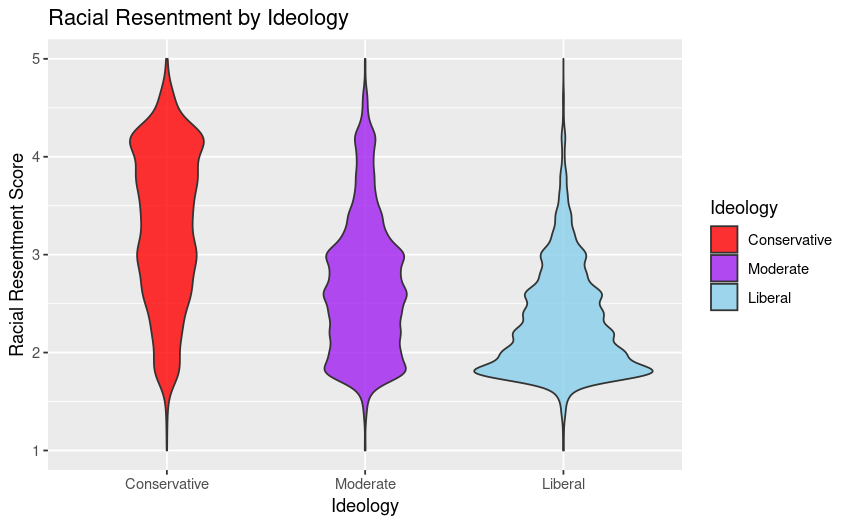
This plot shows an unweighted mean of racial resentment scores from the industry-standard 5-point-5-question grid instrument and ideology categories created by collapsing the classic 7-point “very liberal” to “very conservative” survey instrument into three discrete categories. As can very clearly be seen here, self-identified conservatives are quite a bit more racially resentful than moderates or liberals. I think this plot speaks for itself, but I have more.
For the math-inclined among you, I have created a linear model to measure the relationship between self-reported ideology and racial resentment. In this model, ideology score scales from “very liberal” = 1 to “very conservative” = 7; and racial resentment score scales from least racially resentful = 1 to most racially resentful = 5. See below:
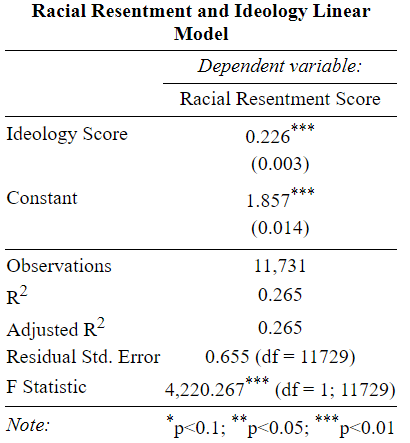
For those of you without experience reading regression tables, do not fret, as I will explain these results. Essentially, this equation (y = mx + b) shows the numerical change in racial resentment score for every 1-unit change in ideology score. In this model, the constant (b) is equal to 1.857 (the predicted value of y when x = 0), and moving from “very conservative” to “conservative” (x), for example, results in a 0.226-point change in racial resentment levels (m). The final output of the model is a predicted racial resentment score (y). This model shows a strong and significant relationship between conservative ideology and racial resentment, meaning that we can now mathematically say conservatives, in aggregate, harbor more racial resentment than liberals. This supports the conclusion drawn by my above graph.
As mentioned, the result of my model is highly statistically significant (denoted by the “***”), meaning that there is only a roughly 1% chance that the results would be as-or-more extreme (have a higher m value) if there existed no relationship between the two variables. The final important note from this model is the R2 value. This is essentially a prediction of how much of the relationship between ideology and racial resentment is explained by this particular model; the value in my model is 0.265. This is a very low R2 value – even for the social sciences, a field notorious for incomplete explanatory models – but it is completely expected in a bivariate model. I have controlled for none of the obvious endogeneity (unexplained variance in a linear model most commonly found when relevant variables are not held as constant) present in race relations – most notably the race of the respondent in question – but my model still accounts for more than 25% of the variance estimated to be present.
Before I let you go, I want to address the invisible elephant in the room present in any survey data on racial resentment – systemic non-response bias. The sample population of the 2020 CES was 61,000 but the number of responses to the racial resentment grid was only roughly 12,000. In survey methodology, this causes the systemic bias known as “non-response error.” This can deleteriously effect the generalizability of the survey data because if certain respondents opt out of questions, the robustness of the randomization is compromised. I assume that most of the people who skipped this question did so out of “social desirability bias.” Social desirability bias usually results in people not answering questions honestly – or at all, in this case – in an effort to appear “desirable” (wonk talk for likeable) to their audience.
I am confident in my hypothesis that the levels of racial resentment for all three groups – conservatives, moderates, and liberals, alike – are higher than my graphs show. However, I still present them as evidence because I think the correlation coefficient (m from our equation earlier) is likely very accurate. While my methodology clearly isn’t perfect – I don’t have time to conduct a survey experiment in the seven days between newsletters – scholarship has consistently pointed to my calculated disparity of about 30%, and I am confident in my results being robust.
I believe my data do a lot to support my claim that racists are almost always conservative. If you are a conservative reading this and feel yourself getting angry, I have two things to tell you – first, thanks for reading this far into a what was likely an upsetting post; second, I am not necessarily calling you, in particular, a racist. All of the evidence for my argument is at the aggregate level. To put that in plain English, the average conservative is substantially more racially resentful than the average liberal, but not all conservatives are more racially resentful than all liberals.
My final point today is a call to action for you, dear reader: whether you are a liberal, a conservative, or somewhere in between, take some time this week to examine your feelings about race in America. Do you support policies to address the measurable differences in opportunity between white Americans and Americans of color? Why or why not? Do you even believe these disparities exist? What is your reasoning? Introspection is one of the best skills you can have in your political toolkit, and I hope that I made you think a little harder about both what you think and why you think it. Have a great week (good luck to my fellow Sooners on your finals), subscribe to the blog, share it with a friend, and I’ll see you next Sunday. Thanks for reading.


 Data Driven Politics
Leave a comment