

Introduction
The 2023 State of the Global Climate Report from the World Meteorological Organization confirmed what many people around the world knew to be the case—climate change is here, and it is only getting worse. Not only was 2023 the hottest year on record, but the planet also broke unsettling records for ocean temperature, sea level rise, and glacier retreat (WMO, 2024). Climate change has a direct impact on the environment, primarily coming through increased extreme weather events, and these events pose a serious socioeconomic risk to people around the world. 2023 saw record breaking wildfires, flooding, extreme heat, drought, and other natural disasters that, compounded with the last half-decade of unusually intense climate activity, played an undeniable role in the rapid increase in food insecurity globally in that same period—doubling from 2019 to 2023 (WMO, 2024). Nations interested in economic growth, political stability, and societal well-being should by necessity be concerned with the rise in global temperatures, but this isn’t always what we observe.
As climate change continues to worsen, people around the globe are certainly taking notice, but their degree of concern varies by level of development and region. In 2021, the United Nations Development Programme conducted the People’s Climate Vote—a survey of 50 countries covering over 56% of the world’s population—and found that 64% of respondents believe that “climate change is a global emergency” (Flynn et al, 2021). Breaking down their results, residents of Western Europe and North America were the most likely respondents to report belief in the climate emergency, with near 72% agreement, while the rest of the world hovered right around the low 60s.
When dividing countries by level of development rather than global region, we see that 72% of People’s Climate Vote respondents from high income countries agreed that climate change was a global emergency, followed by middle income country residents at 62%, and least developed country residents at 58%. The outlier in this subgroup analysis is the response rate from “Small Island Developing States,” coming in at a whopping 74% agreement with the emergency status of climate change.
Perhaps surprisingly, the United States—the global runner-up in total greenhouse gas emissions—was an outlier in both its regional and developmental subgroups, with only 65% of Americans professing belief in the climate emergency. This fits with a broader pattern of mismatched levels of concern and levels of climate disruption in many nations around the world.
If we take from these data that residents of highly developed democracies are more concerned than average, and if we presuppose that highly developed democracies are truly more responsive to their people’s wishes than authoritarian regimes, it would be quite reasonable to hypothesize that democracies to do a better job with handling climate change than do their less-than-democratic counterparts. This is exactly what some scholars began to argue around the fall of the Soviet Union.
Scholarly attempts to explain this relationship began in earnest in the post-cold war 1990s as a reaction to environmental disasters within the former Soviet Union (Schultz and Crockett, 1990) and to the once-prevailing ideas among some environmentalists that democracies focus on economic growth at the expense of the environment (Payne, 1995), among other concerns. While these efforts produced reasonable ideas rooted in sound theory, their authors made the concession that empirical evidence was lacking on this relationship (Payne, 1995). In the three decades since this initial inquiry, researchers have produced such empirical evidence and can now more rigorously examine the role democracy plays in shaping domestic and global environmental policy.
The empirical evidence we now have generally points to a modest, positive association between degree of democratization and success of climate policy outputs, but the evidence that increased democratization leads to better climate policy is still quite weak (Lindvall & Karlsson, 2023).
In this paper, I seek contribute to the literature on climate change policy and democracy by evaluating the hypotheses that (1) Democracies do a better job of mitigating climate change than do less democratic nations, and (2) increased democratization leads to better climate outcomes, ceteris paribus. Using data from Yale’s Environmental Performance Index (Wolf, et al, 2022), V-Dem (Coppedge, et al, 2023), and the World Bank (World Development Indicators), I seek to isolate and estimate the partial effect of democratization on environmental protection globally. In an attempt to infer some causality from these data, I conduct a case study on the Asia Pacific region. These countries are unique because of their extremely rapid industrialization and their inter-region variance in levels of democratization and global cooperation. This will allow me to more clearly explore the effect rising levels of democracy have on climate policy.
This investigation raises several key foreign policy questions. It comes at a time when global action to ensure that the full risks and dangers of climate change are not realized is critical. If democratization does, in fact, reduce the global risk of climate disaster, countries interested in mitigating the social, political, and economic costs of continued global warming would have a compelling reason to intervene in the domestic politics of emerging democracies globally.
An Introduction to Climate Change and Its Consequences
At the most basic level, the climate is defined as the set of weather conditions in an area over a significant period of time (often set at 30 years, or one human generation), and climate change defines the responses of the “climate system” to external (nonweather) factors. Climate is contrasted with weather, which is defined as “the instantaneous state of the atmosphere” (MacCracken and Wilson, 2019). “Climate change,” or the gradual shift in the weather patterns in an area over time, has occurred innumerable times over the history of the earth, and significant climate change is not at all unusual, resulting from accumulated changes in weather over thousands of years. In the modern context, however, “climate change” does not refer to the constant but gradual ebb-and-flow of our aggregate weather patterns, but rather to the rapid, drastic, and disruptive shift in our global climate that has occurred over the last two centuries.
This shift is visualized using data from NOAA in figure 1:
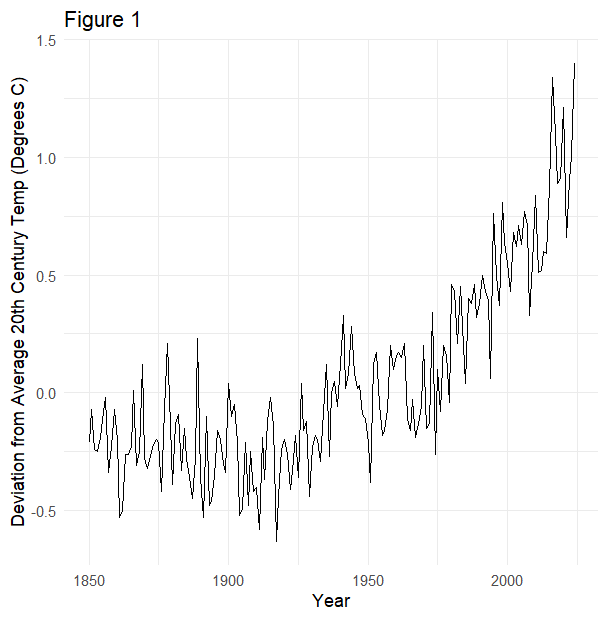
This new phenomenon of anthropogenic (man-made) climate change (shortened to simply “climate change” in this paper) has no precedent in the paleoclimatic record. Since the beginning of the Holocene—or the roughly 12,000 years since the last ice age—climate fluctuations have been limited to about half a degree Celsius. Since the mid-19th century, however, the global average surface air temperature has warmed by about 1 degree Celsius, with some regions seeing warming by over 20 degrees (MacCracken and Wilson, 2019).
Scientists attribute this rapid rate of warming primarily to the use of fossil fuels. Fossil fuels, like coal or petroleum, are combusted to harness their energy, and this combustion releases “greenhouse gases” into the atmosphere. These gases, Carbon Dioxide (CO2), most famous among them, are a critical part of the planet’s atmosphere. They get their name from the “greenhouse effect,” or their ability to absorb and redistribute heat back towards the surface—without them, scientists believe that earth’s temperature wouldn’t break freezing (Lindsey, 2023). But because of the scale at which humans burn fossil fuels to meet our global energy needs, the levels of greenhouse gases in the atmosphere have increased dramatically, thus amplifying the greenhouse effect and rapidly warming the planet. Deforestation, pollution, urbanization, and industrial farming are also said to be causes of climate change (MacCracken and Wilson, 2019).
The consequences of continued global climate change were mentioned in brief before, but they are worth reiterating here. The trend of global warming over the last two centuries has dramatically increased both the frequency and magnitude of natural disasters. Climate change is associated with drought, flooding, famine, tropical storms, wildfires, and many other disruptive natural disasters. These events directly take human lives, but they also destroy infrastructure, hurt economic growth, and exacerbate global inequality (Burke, 2015).
It follows from this brief introduction to climate change that climate change mitigation should be a priority, and that the primary objectives of climate policy ought to be mitigation, or slowing down the warming of the planet and changing of the climate; and adaptation, or helping build national and international systems to assist us in weathering both the short and long term impacts of climate change. (Busby, 2016).
Mitigation efforts are commonly warming targets. The Paris Climate Agreement—the world’s largest and most comprehensive international climate policy agreement—has set the global target of limiting warming to 2˚ C above pre-industrial levels. Considering the 1˚ C the planet has already warmed, this goal is ambitious at best and unrealistic at worst. Meeting it will require “nothing less than a transformation to a decarbonized economy by the middle of this century” (Busby, 2016).
The Paris Agreement also included policies aimed at adaptation, but these were much softer than the mitigation goals. Low-lying island nations and nations in the very early stages of development are more susceptible to climate disaster than wealthy, developed, and relatively secure nations like the United States, so it was originally suggested that wealthy countries should take on the financial burden of helping these at-risk nations adapt to and eventually recover from climate disaster. Due to the potential for the “unlimited legal liability” this policy might cause, wealthy nations rejected it in exchange for substantial one-time payments to at-risk nations (Busby, 2016).
In summary, climate change is primarily caused by greenhouse gas emissions from burning fossil fuels and is exacerbated by deforestation, industrial farming, urbanization, and pollution. “Good” domestic climate policy can come in many forms, including but not limited to caps on greenhouse gas emissions, cap and trade policies, subsidies for renewable energy, or limits on deforestation, pollution, and other ecological damage. “Good” international climate policy primarily comes in the form of international agreements that set warming targets and provide financial assistance for adaptation from wealthy nations to poorer nations who are more at risk. These policies are critical at the local, national, and international level to prevent further climate disaster.
The Democracy-Climate Change Relationship
It should be clear at this point that preventing further climate change should be a priority and that it is in our best interest as a species to put ourselves in the best position possible to achieve our mitigation and adaptation goals. To put ourselves in this advantageous position, it is critical to understand the factors that are most associated with positive climate policy outcomes.
Because climate action is a long-term problem that requires substantial short-term investment to address, nations must be highly motivated to tackle the problem if they want to be effective. Some nations, like the low-lying island nations, are highly motivated due to the existential risk climate change poses to their survival (Falkner, 2016). Other nations, like the United States or China, lack the political will to make the requisite large and transformative changes because of how much their economies rely on greenhouse gas emitting activities. To understand why some countries have acted to address climate change and others have not, scholars have sought to study the factors that lead nations to implement effective climate policy. One potential cause might be the presence of democracy.
Why might democracy improve climate policy? There are several theoretical possibilities. First, democracies are more receptive to the wishes of their citizens than other forms of government. By electing officials, the people in a democracy get to assist in the direction of public policy in general—and climate policy in particular—by electing officials that share their values and beliefs. Many democracies also allow for citizens to protest and petition their governments, thus increasing the awareness of politicians to the desires of their constituents. Because most people in the world are concerned about climate change (Flynn, 2021), we would expect countries that consider public opinion in their decision-making process to do a better job of addressing climate change.
Second, democracies do a better job of cooperating with other democracies than authoritarian states do. Scholars have repeatedly found evidence that democracies are highly cooperative with each other (Mansfield et al, 2002). Democracies also tend to engage each other in bilateral and multilateral trade agreements, and their reliance on each other through trade can help democracies hold each other accountable when making global agreements. Because climate change is a global issue that will require action by the whole world to resolve, and because democracies do a better job cooperating than authoritarian states, one could very reasonably assume that democracies will do a better job of responding to climate change globally.
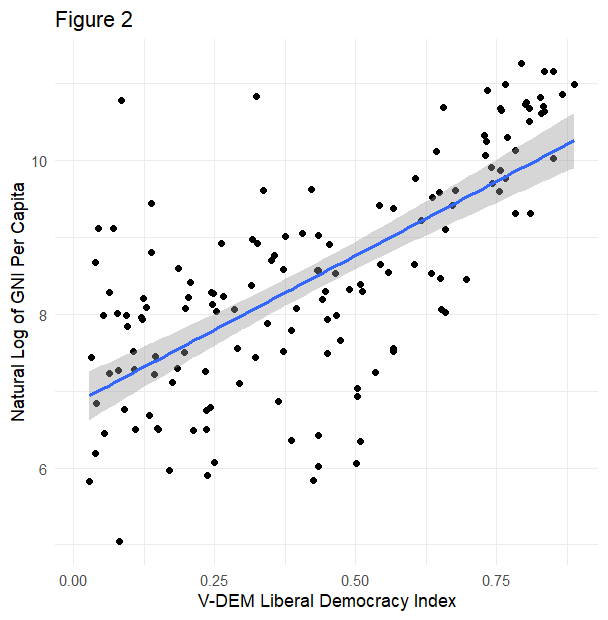
Third, because established democracies tend to have already developed economies (Acemoglu, et al, 2016), they might be more willing to give up emission-producing economic activities because they have other economic options in the service sector. Wealthy democracies are also more likely to produce responsible climate policy than middle income countries and poor countries. As found by Barrett and Graddy, the relationship between economic development and climate policy resembles an upside-down U-shaped curve (Barrett and Graddy, 2000). When countries are very poor, their citizens are highly vulnerable to climate disaster. Most commonly, income rises through industrialization (which produces large amounts of greenhouse gas emissions), and citizens are hesitant to limit these emissions for fear of economic stagnation. But, after income reaches a certain point, citizens again become focused on the environment and climate change and demand regulation and climate policy. The relationship between level of democracy and level of national wealth can be seen in figure 2:
As it turns out, the relationship between climate change and democracy is not as clear as one might expect from the theoretical case outlined above. In a recent meta-analysis of 72 studies, Lindvall and Karlsson report that there does appear to be solid evidence that democracies output more policies aimed at addressing climate change than other forms of government, but that the evidence for the positive impacts of these policies is substantially less conclusive (Lindvall and Karlsson, 2023). While several studies have found that democracies do a better job of mitigating pollution than do authoritarian states (Barrett and Graddy, 2000; Congleton, 1992; Waller and Millard, 1992), still others have found that rising levels of democracy had a negative impact on the environment (Scruggs, 1998; Midlarsky, 1998). The existence of a democracy in a given nation does not by itself increase the quality of climate policy output in a country.
Why might democracy not lead to better climate policy, or even be associated with negative climate results? The primary argument for why democracies are not fit to deal with climate change is their decision-making horizon. Because elections in democracies often happen once every few years, politicians are incentivized to focus on the immediate term future in their policymaking decisions (Andric, 2019). Because climate change requires long-term foresight and planning, democratic leaders worrying about the upcoming election might fail to properly address it.
Modeling the Effect of Democracy on Climate Change
The question now is: how might the relationship between democracy and climate change be statistically evaluated? To accomplish this, I have estimated two multiple ordinary least squares regressions to evaluate the impact of the level of democracy in a nation on its climate performance. The first and most obvious inclusion in this model is a measure of democracy. For this, I have included the V-Dem “liberal democracy index” (V-Dem). The other factors are less straightforward but still rather simple. In their meta-analysis, Lindvall and Karlsson present four main factors that might impact how democracies handle climate change policy, each of which is included (directly or by proxy) in my analysis.
The first is economic growth. In their review of the literature, Lindvall and Karlsson found that “Economic growth does not necessarily lead to democratization, but there is empirical evidence for a certain level of economic welfare to be a prerequisite for the development of liberal democracy” (Lindvall and Karlsson, 2023). For this reason, I include both measures of national wealth (gross national income per capita), and economic growth (annual percentage growth of gross national income per capita) (World Bank WDI).
In order to improve linearity between EPI and GNI per capita, to correct for skewness, and to give a percentage change partial effect interpretation rather than a nominal dollar change interpretation, the measure of national wealth included in both models estimated here is the natural log of GNI per capita. The inclusion of a quadratic term for GNI per capita comes from the work of Scott Barrett and Kathryn Graddy, as mentioned above, in which they suggest that income has a “downward U-curve” relationship with climate policy outcomes. Their results indicate that as income rises to middle-income levels, their climate policy gets worse, but past a certain critical point, rising levels of income are associated with better climate policy outcomes (Barrett and Graddy, 2000).
Lindvall and Karlsson’s second major factor in climate policy performance is income inequality. In societies where income is not distributed equally, citizens at the bottom of the distribution are unable to have their voices heard to the same degree they might in a more equal society, and because access to resources is one determinant of how well an individual can respond to climate change, the people with the most ability to involve themselves in politics also tend to be the people with the least to lose (Lindvall and Karlsson, 2023). For this reason, I have included a measure of inequality (share of income held by the top 10% of citizens) (World Bank WDI). Because only 54 of the 102 samples in my data included measures of this variable, it necessitated the estimation of a second model.
The third factor identified by Lindvall and Karlsson is the level of fossil fuel dependence in an economy. The intuition behind this is quite straightforward nations whose economies rely more on fossil fuels have more to lose by capping and eventually transitioning away from fossil fuels. I tested measures of fossil fuel imports and exports as proxies, but when an F-test of joint significance was conducted to evaluate their inclusion, the resulting p-value was 0.2284, meaning there was not sufficient evidence to warrant the rejection of the null hypothesis and justify their inclusion in my model.
The fourth factor identified in the meta-analysis in question is regime corruption. Corrupt regimes might give special treatment to large, highly polluting multinationals in their borders in a way that less corrupt nations do not. Corrupt governments are also less likely to be responsive to the needs and wishes of their citizens. For this reason, I have included V-Dem’s “Regime Corruption Index.” (V-Dem).
The dependent variable in this investigation is Yale’s environmental performance index (Wolff, et al, 2022). The EPI is a data driven estimate of climate policy performance. It uses over 40 variables, including measures of mitigation and adaptation policy, to calculate scores for nations which range from 0 (worst) to 100 (best). The EPI was chosen over other leading indicators because many others do not include data on developing countries, and one of my main explanatory variables evaluates the impact of level of development on climate change policy performance, making a wide range of development in my sample a high priority.
The summary statistics for all variables included in these models are included below:


To account for the heteroskedasticity likely present in these data, both regressions were estimated with heteroskedasticity and autocorrelation robust standard errors (HAC). Table 1 shows the results of estimating these regressions:
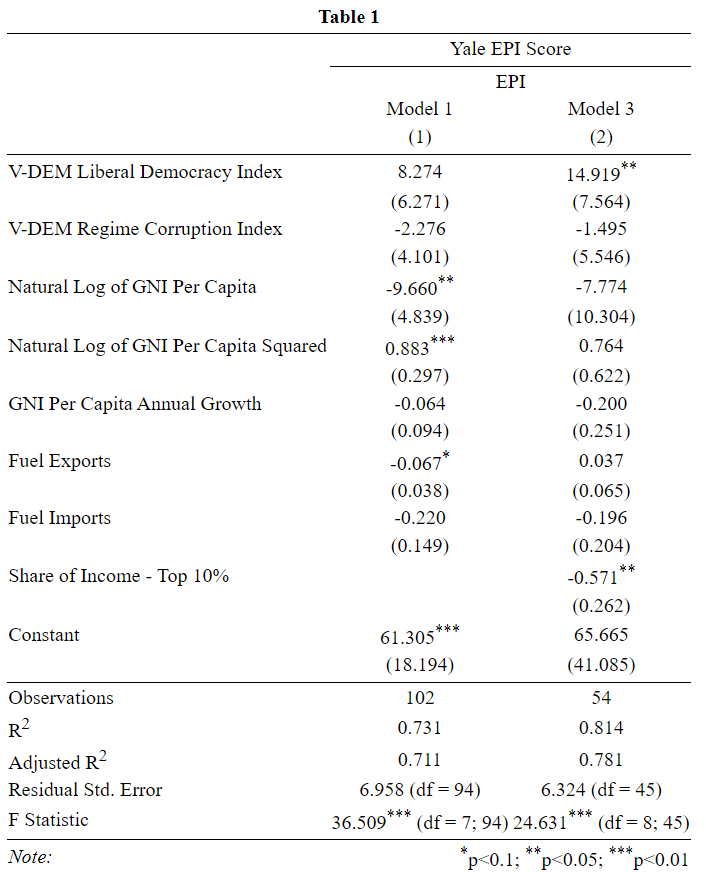
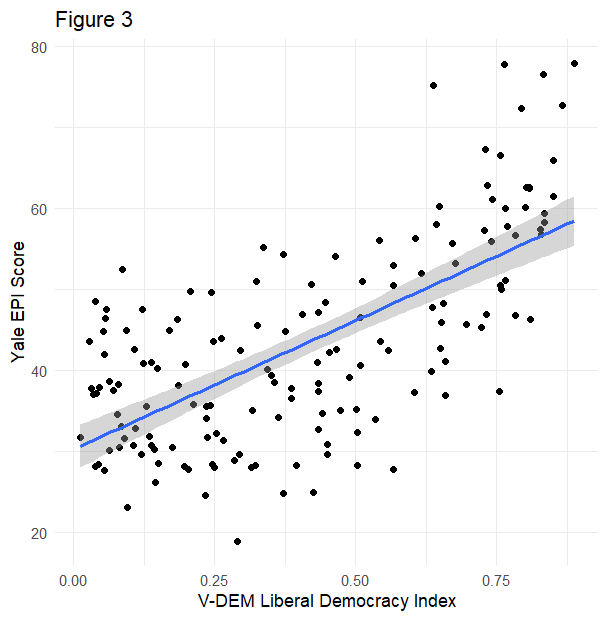
Immediately, liberal democracy has a relatively substantial partial effect on EPI score. Liberal democracy is statistically significant only in the second model, but it is important to keep in mind that statistical significance is harder to achieve in samples this small. In model 1, the partial effect should be interpreted as “on average, going from a V-Dem score of 0 to a V-Dem score of 1 increases the EPI score by 4.18 points, all else equal.” A similar interpretation should be done in model 2, but with an effect size of 13.482. The magnitude of the effect sizes in the two models and the statistical significance of the coefficient in the second model point to the possibility of democracy influencing climate policy performance, but like the rest of the literature, it is somewhat inconclusive. To visualize these findings, I have plotted Yale EPI Scores against V-Dem’s Liberal Democracy Index in Figure 3:
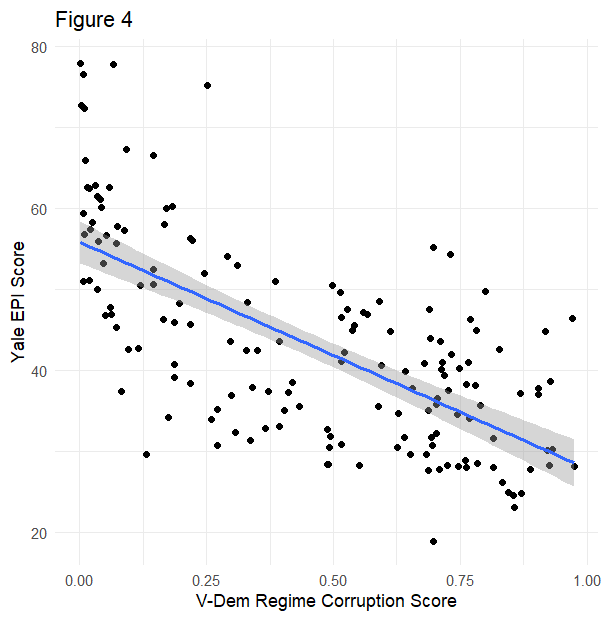
While the signs on regime corruption in both models are negative, they are both highly insignificant so they should not be interpreted with too much confidence. Nonetheless, a scatterplot of EPI against regime corruption appears in figure 4:
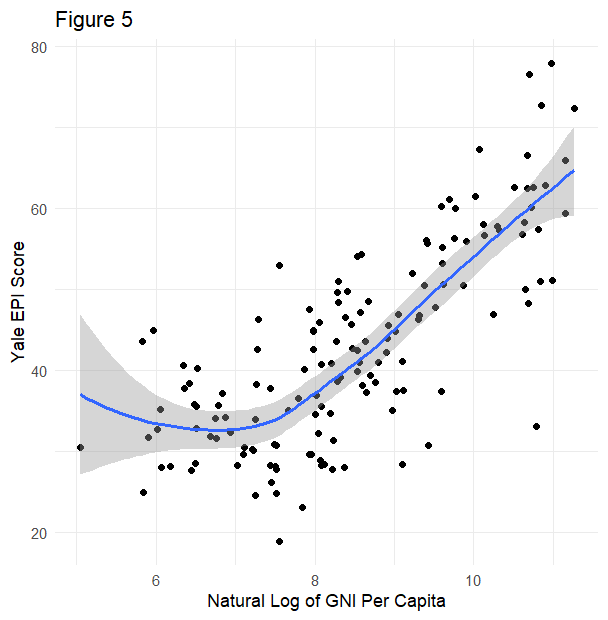
Another finding of note is that the coefficients on the quadratic of GNI per capita matches the “upside down U” we would expect from the literature. While the coefficient on the constant term being negative and on the squared term being positive, it appears that our parabolic relationship might be concave up, but it is important to remember that the upside-down U refers to climate policy getting worse between low and moderate development levels and improving between moderate and high development levels. Because our EPI scale is the inverse, we see in this relationship climate policy worsening until a critical point of development at which it begins to improve.
Interpreting the partial effects of a level-log model such as this can be more difficult than a level-level model. The interpretation here is “on average, for every Δx% increase in national income, we find a (-0.13025+ 2(0.01081*Δx)) change in EPI score, ceteris paribus,” where the direction of the change depends on which side of the critical point you are on. To improve in the interpretation of this relationship, I have plotted EPI score against the natural log of GNI per capita in figure 5, remembering that an upward U in this case matches with the findings of the upside down U from the literature:
Finally, with a coefficient of -0.501, income inequality appears to have a significant, though quite small partial effect on climate outcomes. This, again, fits closely with what we would expect from the literature. EPI is plotted against income inequality in figure 6:

A summary of the findings from these models would be that democracy does seem to be positively correlated with environmental policy performance, but that this relationship is far from conclusive—even when income level, economic growth, corruption level, and fossil fuel dependence are partialed out. Furthermore, assuming causality from these results would be a mistake because the cross-sectional nature of the multiple OLS models does not account for the temporal dimension between democracy and environmental performance. In other words, it cannot show that democracy leads to better climate outcomes, ceteris paribus. Because finding some level of causality is the interest of this investigation, another method of analysis is required.
Climate Change and Democracy Case Study: Japan and China
To begin this case study, an explanation of case selection is in order. Japan and China are excellent candidates for this case study because they are relatively similar economically but quite different politically. Japan is a developed democracy while China is an authoritarian nation. They are also quite different environmentally. According to the Yale EPI, Japan ranks 25 out of the 180 nations studied with an above average EPI score of 57.2, while China ranks in at 160 with a paltry 28.4 EPI score (Wolf, et al, 2023).
To note their similarities, Japan and China are both examples of the Asian Economic Miracle in the second half of the 20th Century. Japan went from a U.S. occupied state with crippled infrastructure and a broken economy in the 1940s to the world’s second largest in the 1970s and 80s (Kageyama, 2024). Despite faltering in the 1990s and suffering from three decades of economic stagnation and further complications due to Covid, called the “three lost decades” by subject matter experts (Fukao et al, 2021), Japan is still the world’s fourth largest economy, with a nominal GDP of $4.2 trillion and an impressive per-capita GDP of $46,971 (OECD Data). Despite not being in particularly good shape at present, Japan is still an economic development success story for the ages.
Japan’s environmental policy has changed drastically from the 1970s to today. In the 60s and 70s, Japan was the second largest consumer of petroleum, but after the OPEC oil embargo of the 1970s dramatically cut their access to oil, they became interested in nuclear energy. (Yoshida, 2020). Despite not being initially motivated directly by environmental policy reasons, Japan’s shift reflects a government structure that takes the material needs of its citizens into account and can be seen as a framework for how democracies impacted by climate disaster can shift away from fossil fuels and towards renewable energy in order to prioritize the needs and wishes of their citizens.
China had a similarly remarkable story. In 1978, China was “one of the most closed economies in the world” and was not a major player globally (Managi and Kaneko, 2005). Since then, they have averaged a break-neck rate of 9% annual growth and are the world’s second-largest economy, with a nominal GDP of $17.96 trillion and a per capita GDP of $21,482.60.
For China, it would be a gross understatement to say that they have a long way to go on the climate policy front. At present, they are the world’s largest greenhouse gas emitter with no clear way down. According to Lindsay Maizland, China’s environmental crisis is the direct “result of decades of rapid industrialization” (Maizland, 2021). While their environmental crisis threatens everyone long term, their people are suffering in the immediate term with their notoriously bad air quality, contaminated soil, and regional water scarcity. Their people are currently feeling the effects of their poor environmental policy, but because their authoritarian government does not incorporate public opinion into its decision-making process, they show no plans of changing their ways anytime soon.
Despite pledging publicly to reach carbon neutrality by 2060, China has undertaken a global economic initiative known as The Belt and Road. This project aims to build infrastructure in developing countries in exchange for loyalty to China and is poised to undo any climate policy undertaken domestically (Maizland, 2024). China is the epitome of an authoritarian nation prioritizing national economic growth over the material needs of its citizens and clearly contrasts itself with Japan when they were faced with their own energy crisis.
I argue here that the main contributor to the variance in Chinese and Japanese climate policy is their level of democracy. In recent years, Japan has sped up their commitment to reaching carbon neutrality, and the world economic forum attributes this acceleration to stakeholders from around the country—in both government and business—pushing for climate change reform (Kutty, 2023). The responsiveness of Japan’s government to national stakeholders can be contrasted with China. In China, dissent is punished, and often harshly. In 2012, a series of environmental protests broke out in Shifang, China, and while they successfully got construction of a copper plant halted (their main demand), it was not without great resistance in the form of police brutality towards protesters (The Guardian, 2012). The contrast between the Japanese government working directly with business leaders to reach carbon neutrality and the Chinese government giving into the demands of their citizens only after meeting them with violent resistance is but one example of how democracies are better equipped to incorporate public opinion on climate change policy, which often results in better climate policy outcomes.
Conclusion
When returning to hypothesis (1) from the introduction, that is, democracies do a better job of addressing climate change than do less democratic forms of government, the answer from my analysis and from the surrounding literature appears to be yes, or at the very least, most likely. When holding for what the literature says to be the largest determinants of environmental success, that is, sufficient economic development, corruption, inequality, and fossil fuel dependence, my analysis concludes that democracy is positively associated with better climate policy. Turning to the second hypothesis, even when taking the case study of China and Japan into account, it is incorrect to declare with any certainty that democracy definitely has a causal effect on climate policy outcomes. While Japan’s responsiveness to an energy emergency is emblematic of how democracies can adapt to change, and China’s resistance to addressing the very real material consequences of its environment-damaging industrialization represent how, all too often, authoritarian regimes can put their own wishes ahead of those of their people, the evidence is just not sufficient to declare this relationship causal.
Turning then to policy, the implications of this research are numerous. One might conclude that if democracies do, in fact, have a better climate record than less-democratic forms of government, climate change mitigation might be a reason to undertake democracy promotion internationally. Ignoring for a moment the very mixed record of democracy promotion campaigns historically (Downes and Monten, 2013), it is unwise to assume establishing a new democracy in a nation will lead to better environmental outcomes.
While democracy is certainly associated with better climate outcomes, one must consider the material differences between established democracies like in the United States and a fledgling democracy in a nation without much democratic history. Because the requisite changes to address climate change are “transformative” in nature (Busby, 2016), leaders in a new democracy who are still attempting to get their footing politically should be expected to be unwilling to commit to the huge changes required for “good” climate policy.
A more intelligent conclusion to draw from this analysis, then, is that nations interested in pursuing a better international climate agenda should focus first on working with other developed democracies. These interested nations should use the fact that democracies collaborate better than other types of governments to push the nations that are highly democratic but still lagging environmentally to fall in line. Tackling climate change should be a top priority for the world at large. Developed democracies are the best hope we have for acting in time to mitigate the coming climate disaster, and they owe it to humanity to listen to their people and do what is right.
Works Cited
“Anti-Pollution Protesters Halt Construction of Copper Plant in China.” The Guardian, Guardian News and Media, 3 July 2012, http://www.theguardian.com/world/2012/jul/03/china-anti-pollution-protest-copper.
Acemoglu, Daron, et al. “Democracy does cause growth.” Journal of political economy 127.1 (2019): 47-100.
Andrić, Vuko. “Iñigo González-Ricoy and Axel Gosseries (eds.): Institutions for Future Generations: Oxford University Press, 2016, xv+ 432 pp,£ 65.00, ISBN: 978-0-19-874695-9 (Hardback).” (2019): 481-486.
Barrett, Scott, and Kathryn Graddy. “Freedom, growth, and the environment.” Environment and development economics 5.4 (2000): 433-456.
Burke, Marshall. The Global Economic Impacts of Climate Change. Stanford Woods Institute for the Environment, 2015. JSTOR, http://www.jstor.org/stable/resrep37213. Accessed 7 Apr. 2024.
Busby, Joshua. “After Paris: Good Enough Climate Governance.” Current History, vol. 115, no. 777, 2016, pp. 3–9. JSTOR, https://www.jstor.org/stable/48614126. Accessed 7 Apr. 2024.
Congleton, Roger D. “Political institutions and pollution control.” The review of economics and statistics (1992): 412-421.
Coppedge, Michael, et al. 2023. “V-Dem [Country-Year/Country-Date] Dataset v13” Varieties of Democracy (V-Dem) Project. https://doi.org/10.23696/vdemds23.
Falkner, Robert. “The Paris Agreement and the new logic of international climate politics.” International Affairs 92.5 (2016): 1107-1125.
Flynn, Cassie, et al. “UNDP People’s Climate Vote.” The Peoples’ Climate Vote, UNDP-Oxford University, 26 Jan. 2021, http://www.undp.org/sites/g/files/zskgke326/files/publications/UNDP-Oxford-Peoples-Climate-Vote-Results.pdf.
Fukao, Kyoji, Young Gak Kim, and Hyeog Ug Kwon. “The causes of Japan’s economic slowdown: an analysis based on the Japan Industrial Productivity Database.” International Productivity Monitor 40 (2021): 56-88.
“Japan – OECD Data.” theOECD, data.oecd.org/japan.htm. Accessed 7 Apr. 2024.
Kageyama, Yuri. Japan Slips into a Recession and Loses Its Spot as the World’s Third-Largest Economy, The Associated Press, 15 Feb. 2024.
Kutty, Naoko. “How Japan Is Accelerating Efforts towards a Carbon-Neutral Society.” World Economic Forum, 16 Jan. 2023, www.weforum.org/agenda/2023/01/davos23-japan-accelerate-efforts-carbon-neutral-society/#:~:text=Japan%20is%20among%20a%20group,also%20underway%20to%20reduce%20emissions.
Lindsey, Rebecca. “Climate Change: Atmospheric Carbon Dioxide.” NOAA Climate.Gov, 12 May 2023, http://www.climate.gov/news-features/understanding-climate/climate-change-atmospheric-carbon-dioxide#:~:text=Carbon%20dioxide%20is%20Earth’s%20most,including%20back%20toward%20Earth’s%20surface.
Lindvall, Daniel, and Mikael Karlsson. “Exploring the democracy-climate nexus: A review of correlations between democracy and climate policy performance.” Climate Policy, vol. 24, no. 1, 10 Sept. 2023, pp. 87–103, https://doi.org/10.1080/14693062.2023.2256697.
MACCRACKEN, MICHAEL C., and EDWARD O. WILSON. “What Is Climate Change?” Biodiversity and Climate Change: Transforming the Biosphere, edited by THOMAS E. LOVEJOY and LEE HANNAH, Yale University Press, 2019, pp. 12–22. JSTOR, https://doi.org/10.2307/j.ctv8jnzw1.7. Accessed 7 Apr. 2024.
Managi, Shunsuke, and Shinji Kaneko. Chinese economic development and the environment. Edward Elgar Publishing, 2010.
Maizland, Lindsay. “China’s Fight against Climate Change and Environmental Degradation.” Council on Foreign Relations, Council on Foreign Relations, 19 May 2021, http://www.cfr.org/backgrounder/china-climate-change-policies-environmental-degradation.
Mansfield, Edward D., et al. “Why Democracies Cooperate More: Electoral Control and International Trade Agreements.” International Organization, vol. 56, no. 3, 2002, pp. 477–513. JSTOR, http://www.jstor.org/stable/3078586. Accessed 7 Apr. 2024.
Midlarsky, Manus I. “Democracy and the environment: an empirical assessment.” Journal of Peace Research 35.3 (1998): 341-361.
NOAA National Centers for Environmental information, Climate at a Glance: Global Time Series, published March 2024, retrieved on April 7, 2024 from https://www.ncei.noaa.gov/access/monitoring/climate-at-a-glance/global/time-series
Payne, Rodger A. “Freedom and the environment.” J. Democracy 6 (1995): 41.
Schultz, Cynthia B., and Tamara Raye Crockett. “Economic development, democratization, and environmental protection in Eastern Europe.” BC Envtl. Aff. L. Rev. 18 (1990): 53.
Waller, Michael, and Frances Millard. “Environmental politics in eastern Europe.” Environmental Politics 1.2 (1992): 159-185.
WMO. State of the Global Climate 2023, World Meteorological Organization , 19 Mar. 2024, library.wmo.int/records/item/68835-state-of-the-global-climate-2023.
Wolf, M. J., Emerson, J. W., Esty, D. C., de Sherbinin, A., Wendling, Z. A., et al. (2022). 2022 Environmental Performance Index. New Haven, CT: Yale Center for Environmental Law & Policy. epi.yale.edu
“World Development Indicators.” DataBank, databank.worldbank.org/source/world-development-indicators#. Accessed 7 Apr. 2024.
Yoshida, Phyllis Genther. “Japan’s Energy Policy Since 1945: Seeking Energy Security.” Japan’s Nuclear Reactor Fleet: The Geopolitical and Climate Implications of Accelerated Decommissioning, Atlantic Council, 2020, pp. 8–11. JSTOR, http://www.jstor.org/stable/resrep30947.6. Accessed 7 Apr. 2024.
 Data Driven Politics
Leave a comment