
It’s not a hot take to say the economy matters in elections – that fact has been well-known to social scientists for several decades. Much more qualified people have written extensively about this relationship, including the authors of one of my favorite studies I’ve read recently. Both reading that study and my declaration of an economics minor last month have got me thinking about how the weird and scary state of our global economy might impact the sure-to-be unpredictable 2024 election.
Despite my best efforts to pretend its just a bad dream, Donald Trump appears to be the frontrunner in 2024. Trump is in a very unique position heading into the Republican Primary, but his reputation on economics might be the biggest wildcard.
Mr. Trump presided over an incredibly confusing time in the United States, and the economy certainly reflected that. He was head-honcho during both the second half of the post-2008 financial crisis recovery, and during the Covid-19 recession, with the causes for both periods seeming to be unrelated to Mr. Trump’s actions as president. This combination of both boom and bust within his term and the lack of a clear relationship between Mr. Trump’s actions and the health of the economy have landed us in an all-too-familiar public opinion phenomenon: no one can agree on how effective Mr. Trump would be as President during economic turbulence. Because there is no common understanding of Mr. Trump’s economic ability, it is challenging to predict how people’s political behavior will be impacted by the economy in the 2024 Republican Primary
One interesting factor to look at when attempting to forecast the 2024 election is the degree to which people’s personal economic conditions and their economic perceptions influenced their opinion of Mr. Trump in 2020. To do this, I made two treemaps (with data sourced from the 2020 CES). In these treemaps – one for change in personal household income and one for perception of national economic health – voters are broken into 5 categories, and the larger the category on the plot, the more the people assigned to that category approved of Mr. Trump on average. See below:
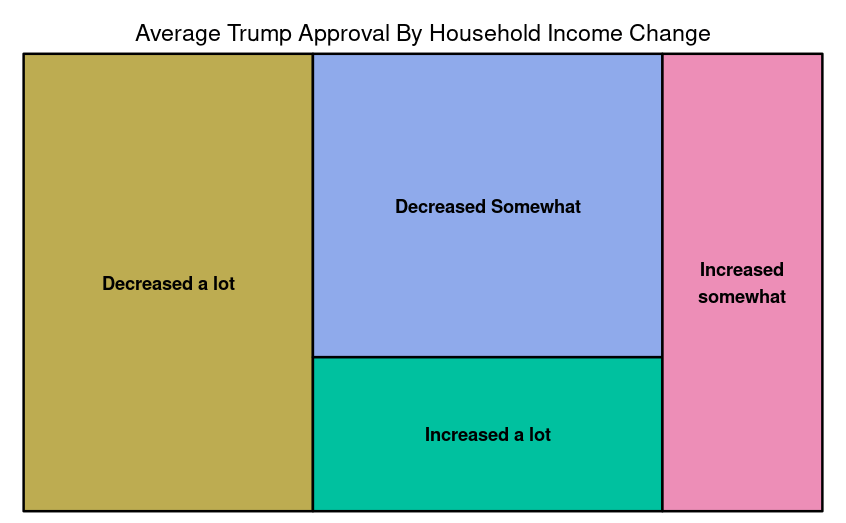
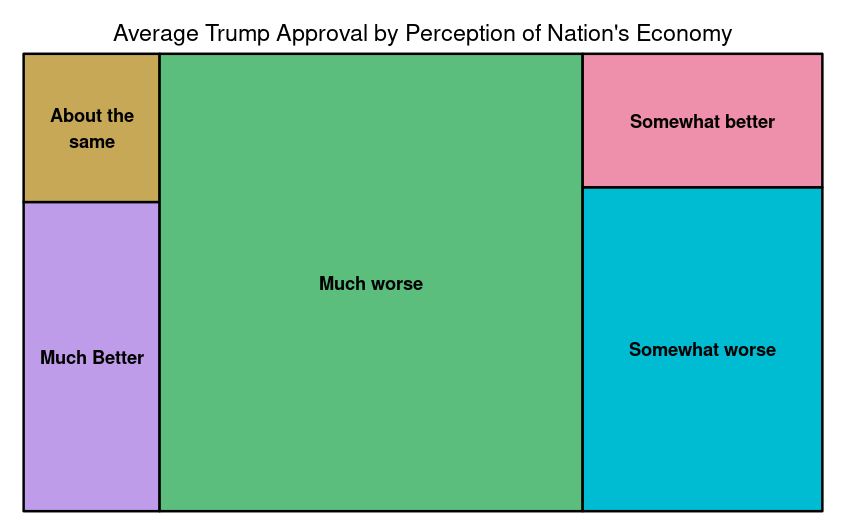
As can clearly be seen, if you made less money in 2020 than in 2019, you probably like Trump more; likewise if you thought the economy got worse in 2020. The very obvious endogeneity in these graphs is 2019 income and economic perception, but I would argue that matters less than it might seem on the surface. White collar workers (the group known for having college degrees, living in cities, and therefore voting blue) certainly took hits to their incomes during the Covid-19 lockdowns, but workers in the service industry (whose allegiances are harder to predict) were hit much harder.
My hypothesis for why we see the disproportionate support for Mr. Trump in those groups who were the biggest losers leading up to the 2020 election is the appeal of his anti-establishment rhetoric to those who are struggling. If you feel that life in your nation is going generally well, you are obviously less likely to buy into a world view in which the elites are out to get you; if you and your community are struggling (or you think you are, at least), a worldview in which these struggles have been thrust upon you by a group of powerful villains can be deeply comforting.
Now the important question – how does my theory about the relationship between economic perception and the efficacy of Mr. Trump’s rhetoric apply to 2024? I see three possible cases for his campaign:
First, the economy is mostly recovered by early 2024, and Mr. Trump’s language of existential evil bearing down on the white working class doesn’t land – in this world, I see Trump losing the primary to Ron DeSantis – a man with a questionable but undeniably coherent philosophy on running an economy and a whole laundry-list of other seemingly compelling grievances with Mr. Biden and the Democrats. Early polling indicates that Mr. DeSantis would likely beat Mr. Biden in a hypothetical general election. I will almost certainly return to this potential outcome in a future post.
Second, the economy tanks, banks fail, unemployment spikes, and Mr. Trump is able to run away with both the primary and the general election. In this world, I think Mr. Trump is able to weaponize his wrecking-ball political reputation and ride the “I alone can fix it” campaign promise to another four years in office.
Third – and probably most likely – the economy remains in limbo, and your guess is as good as mine. As it stands today, Mr. Trump’s political influence seems rather questionable. He is clearly the frontrunner at this point, but as indictments begin to come and his sanity is called into question more frequently, I genuinely do not know how he would fare in the Republican Primary (not to mention the general election). This topic will also most likely be a future post.
The basic conclusion I want you to take from this post is simple – if the economy is strong, Mr. Trump will lose in 2024; if it crashes, he will likely win. The top priority of President Biden’s campaign should be to loudly and proudly call attention to the apparent economic recovery we are currently seeing. Mr. Biden should hammer home how effective his administration’s policies have been at improving our economy, and how important his landmark Inflation Reduction Act will be for continuing our march upward, as well as calling attention to the uncertainty almost guaranteed to follow a Trump victory in 2024.
I cannot stress enough how unpredictable 2024 will be, but I hope you join me every Sunday at 5:00 pm central time for the Data Driven Politics newsletter.

 Data Driven Politics
Leave a comment